Search the SPREP Catalogue

Refine Search Results

Language

Available Online

Available Online

14 result(s) found.

Sort by

You searched for

Climate change and food security in Pacific island countries
Climate Change Resilience, Biodiversity Conservation
Available Online

FAO/SPREP/USP

2008
The Fourth Assessment Report of the IPCC (IPCC AR4) Working Group II (2007) identifies small island states as being among the most vulnerable countries of the world to the adverse impacts of climate change. Hay, el al.y (2003) in discussing the Pacific's observed climate noted that compared to earlier historical records during the twentieth century, the southern Pacific had experienced a significantly drier and warmer climate (by 15 percent and 0.8°C, respectively). The Central Equatorial Pacific is facing more intensive rain (about 30 percent) and a similarly hotter climate (0.6°C), and sea surface temperatures in both areas have increased by about 0.4°C. These conditions are linked to an increased frequency of El Nino episodes since the 1970s (without alternating La Nina events). Other studies show that climate projections for the South Pacific indicate warming of 0.8 to 1.8°C and precipitation changes that range from -8 to +7 percent by mid-century (Ruosteenoja, el ai, 2003). By the end of the century, projected warming is 1.0 to 3.1°C and precipitation changes range from -14 to +14 percent. Projections of globally averaged sea-level rise range from 0.18 m to 0.58 m in 2090-2099 relative to 1980-1999; while tropical cyclones are likely to become more intense, have higher peak wind speeds, and bring heavier rainfall (IPCC, 2007). Thus, it is clear that there are winners and losers when it comes to climate and food security with mostly the countries in the mid to higher latitudes benefiting from global warming and the small island countries of the Pacific in the warmer latitudes standing to lose the most. The IPCC has concluded that the mounting evidence shows that climate change is unequivocally happening and may worsen in future; there is a need to act urgently to minimize these impacts.
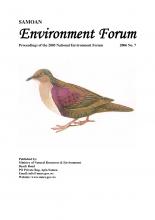
Samoan Environment Forum: proceedings of the 2005 National Environment Forum|The fact-or-myth of Samoan cultural heritage: personal reflections on family oral history / Tu'u'u Ieti Taule'alo|Samoan and Japan: concerns over mangroves development / Juliet Boon-Nanai|Status of hawksbill turtle nesting in Samoa, 2003/2004 / Mauigoa Lui Bell, Malama S. Momoemausu, Juney Ward & Malaki Iakopo|Participatory approaches for environmental initiatives - community consultation in Samoa / Natalie Mitchell|Emotional intelligence, management concept: a contributing factor for effective service delivery / Mulipola Ausetalia Titimaea|Tropical cyclone forecasting: theory and practical application - case study of tropical cyclone Olaf 2005 / Sala Sagato Tuiafiso|Samoa and the World Heritage Convention - is Samoa ready for world heritage listing / Tuiolo Schuster|Exploring the status of tsunami early warning systems in Samoa / Shaun P. Williams & Aliimalemanu F.M. Leavasa|Determination of a mean daily discharge values for Faleaseela River: implications for population water demand / Masina Nagau Chun, Iosefatu Eti & Mulipola A. Titimaea
Available Online

MNRE

2006
The community based conservation (CBC)paradigm predicts that sustainable biodiversity can only be achieved if local people perceive benefits from conservation. Through interviews, the situation in Samoa portrays that the CBC of mangroves was received with apprehension because the mangrove biodiversity was more significant than sustaining the livelihood of the local communities. In contrast, Iriomote Island residents were able to achieve maximum socio-economic benefits but to the extent that they were over commercializing the mangrove ecosystem. More research is imperative to find out how biodiversity conservation can be married with sustainable development objectives to sustain the local communities' livelihood.