Search the SPREP Catalogue

Refine Search Results

Tags / Keywords

Available Online

Tags / Keywords

Available Online

118 result(s) found.

Sort by

You searched for

  • Collection Climate Change Resilience
    X
  • Related Countries Worldwide
    X
Northern Australian Indigenous Land and Sea Management Alliance (NAILSMA) climate change adaptation workshop report
Climate Change Resilience
Available Online

NAILSMA

2010
It was made clear from all of the presentations that climate change is occurring and its consequences, or changes attributed to climate change, are manifestly being observed and noted by Traditional owners on country in ways that richly complement the much more publicised knowledge emerging from the “western” scientific paradigm. The impacts are both direct and indirect, obvious and variously disguised, environmental and social. The way to mitigate impacts and adapt to changes varies across natural and human landscapes. One of the key features in north Australia is the relatively large proportion of Indigenous people who are particularly vulnerable, not only to obvious physical impacts of climate change effects like more frequent severe cyclones; but to background conditions such as economic underinvestment, poverty, health issues and the vicissitudes of policy making. Such conditions in over-governed, under-resourced communities (remote and urban) exacerbate problems with adaptation to change and capacity to respond. Climate change in north Australia cannot be treated in isolation from existing conditions of life and is increasingly affecting Indigenous lives everywhere, becoming a key stimulus for driving Indigenous capacity, response and adaptation to short and long term changes in their physical and social environment.
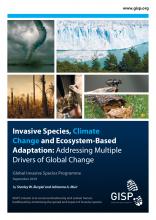
Invasive species, climate change and ecosystem-based adaptation: addressing multiple drivers of global change
Climate Change Resilience, BRB
Available Online

Burglele Stanley W.

,

Muir Adrianna A

2010
This report is targeted at policy-makers, particularly those responsible for developing climate mitigation and adaption strategies that address issues like conservation, ecosystem services, agriculture and sustainable livelihoods. It focuses on the primary linkages between invasive species and climate change, as well as the secondary and tertiary interactions of their corresponding impacts. Finally, the enclosed recommendations are intended to provide guidance on the best ways to integrate invasive species prevention and management into the consideration of climate change responses across a range of sectors. Building on a review of existing scientific and conservation literature (which is frequently centered on well-studied invasive species in developed countries), our research has reaffirmed that there are significant gaps and questions about the intersection of these two major drivers of change. The case studies included below highlight key relationships and questions related to invasive species, climate change and the role of ecosystem-based adaptation. The three key messages that can be distilled from this report are: 1. Climate change will have direct and second order impacts that facilitate the introduction, establishment and/or spread of invasive species. 2.Invasive species can increase the vulnerability of ecosystems to other climate-related stressors and also reduce their potential to sequester greenhouse gasses. 3.Using an ecosystem-based adaptation approach, these pressures on ecosystems and their ability to provide important services can be offset by preventing the introduction of new invasive species and by eradicating or controlling those damaging species already present.
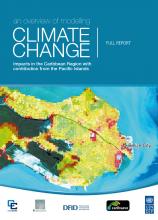
An overview of modeling climate change : impacts in the Caribbean region with contribution from the Pacific Islands, United Nations Development Programme (UNDP), Barbados, West Indies
Climate Change Resilience, Biodiversity Conservation
Available Online

Simpson, M.C...[et al.]

2009
The nations of CARICOM16 in the Caribbean together with Pacific island countries contribute less than 1% to global greenhouse gas (GHG) emissions (approx. 0.33%17 and 0.03%18 respectively), yet these countries are expected to be among the earliest and most impacted by climate change in the coming decades and are least able to adapt to climate change impacts. These nations’ relative isolation, small land masses, their concentrations of population and infrastructure in coastal areas, limited economic base and dependency on natural resources, combined with limited financial, technical and institutional capacity all exacerbates their vulnerability to extreme events and climate change impacts. Stabilising global GHG emissions and obtaining greater support for adaptation strategies are fundamental priorities for the Caribbean Basin and Pacific island countries. CARICOM leaders recently unveiled their collective position that global warming should be held to no more than 1.5°C19 and continue to develop a Climate Change Strategic Plan. The Pacific island countries have expressed their priorities for addressing climate change regionally through the Pacific Leaders’ Call to Action on Climate Change20 and the Pacific Islands Framework for Action on Climate Change 2006-2015.21